Friday, December 4, 2009

Israel/Palestine Part 1--Jerusalem

I spent this past week traveling through Israel and Palestine (two places, no matter what the US government claims). I'm going to separate the trip into separate blog posts by city to make writing and reading about the trip a bit more manageable.

First up: Jerusalem
Wednesday night, 9 of us (American study abroad students from AUC) climbed onto a bus at 11pm outside our dorm, headed for Taba, the Egyptian city at the border with Israel. The ride took about 5 hours, and we arrived in Taba at about 4 in the morning. The 9 of us were split into two traveling groups: JM, Nick and I, and the other 6. We entered the Israeli side after some discussion with the Egyptian border officers and were immediately pulled aside for questioning. After most of us (not including me) were questioned, they let us go through the normal process. We assumed the questioning was over, but that was only the preliminary round. My group of 3 made it through rather quickly, despite the Lebanese stamps on both my passport and JM's. We got into a cab on the other side and rode to Eilat, the closest Israeli city to the border, about 10 minutes away. From there, we intended to take the first bus to Jerusalem; however, it was sold out and we had to wait around til 2 for the next one. That worked out ok, since the other 6 were stuck at the border for a few hours as the Israelis questioned the two Muslim girls. We met up with the rest of the group and took the bus up to Jerusalem, where we split to go to our separate hostels. Not 10 minutes after arriving in Jerusalem, JM and I crossed the street when there was a red "Don't Walk" light; apparently that's actually illegal in Israel (as it is in the States, though it's never enforced there), and we received 100 shekel tickets, about $30. Welcome to Israel.
So the three of us checked into our hostel, the Palm Hotel. We were staying in a mixed dorm room with about 5 other people. It had no heat. For $11/night, I guess we can't complain. An extra blanket did the trick. Other than the lack of heat, the hostel wasn't too bad, just a little dirty. The rest of the hostel had heat, and in fact had free internet with free use of community computers, albeit with a restriction of a half-hour per person, as there were only 2 computers for the hostel. We did also have free breakfast too, which was amazing because they actually had real hummus. In Egypt, it's just tahina (sesame paste, with oil and spices; hummus has chickpeas and is so much better), so I ate far more hummus each morning than I should have.

Day life in Jerusalem:
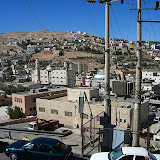
I spent the days with just the other two in my travel group. Our explorations of Jerusalem were restricted mostly to the Old City, venturing outside the walls only to see the Mount of Olives and at night to go to bars or go back to our hostel. We visited the Holy Sepulcher Church, supposedly on the spot where Jesus was crucified. The church is huge; it has rooms commemorating the various aspects of Jesus' crucifixion, including the stone on which Jesus was supposedly lain after he was crucified. Touching it gave me a really weird feeling that persisted for about 10 minutes afterward; I can't explain it, but both JM and Nick agreed.  There is also a room underground where Jesus' cross was allegedly found.

From Israel/Palestine
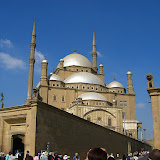
The Dome of the Rock is a mosque that only Muslims are allowed to enter, unless the guards are in a good mood that day. We tried to go into Temple Mount (the area all around the Dome of the Rock), but we were denied entry four times. Oh well. It is easily the most recognizable place in Jerusalem, and I have many pictures of it from various angles. I don't want to mess up the historical and religious significance of it, so you can read about it on the wikipedia page: http://en.wikipedia.org/wiki/Dome_of_the_Rock.

From Israel/Palestine

From Israel/Palestine

We also visited (and touched) the Western Wall, also called the Wailing Wall. It is the most significant place in the Old City for Jews, the only part of a temple left that used to stand on that spot. When it was destroyed, Jews were afraid to rebuild it for fear that they would step on the holiest spot that was reserved only for religious leaders, so they prayed against the Wailing Wall. Again, wikipedia for accurate history and significance: http://en.wikipedia.org/wiki/Wailing_wall.

From Israel/Palestine

There are many other churches and places of religious significance throughout the Old City, too many to remember or really even worth mentioning.

Jerusalem by night:
Our first night in Jerusalem was Thanksgiving, and the closest we got to turkey and the rest of the tradition was burgers and Sam Adams. Oh well, I'll have to wait til Christmas for amazing home-cooked holiday food again. We were pretty tired our first night, so we just headed back to our hostel after dinner. The next night, however, we found a great bar with happy hour until 10. We visited that bar again the third night and proceeded to a dance club across the street. Overall, Jerusalem night life was much better than I expected considering that it's an old, religious city.

Other notes about Jerusalem:
The city is split between West Jerusalem, the Jewish side, and East Jerusalem, the Arab side. There are separate bus systems for Jews and Arabs. When we were looking for our hostel, our cabbie dropped us off nearby in West Jerusalem and upon asking directions, I was given a disgusted look and informed that it was "in the Arab part." We crossed the street into the Arab part, and I immediately felt more at home. They were speaking a language I understand (unlike Hebrew) and felt like a cleaner, nicer version of Cairo.
The food in Jerusalem is AMAZING. Arab food: the shawarma (chopped meat or chicken with spices and such) was much better than Cairo, and they have the best kabobs I've ever had. They also have real hummus, and their falafel is unbelievable. I really miss that food now that I'm back in Cairo. Israeli food: bagels! The delis had the best bagels and cream cheese. They also put tomatoes on them if you want, which I'd never thought of. I had a whole wheat bagel with salmon cream cheese and tomato in the Old City. Amazing.

~~~

From Israel/Palestine

Wednesday, November 25, 2009

I haven't written a post in a while, so I have a couple things to get through.

First of all: Egyptian soccer (kura). This past week, Egypt played Algeria in two different games to decide which team would qualify to advance to the World Cup qualifiers. In the first game, Egypt had to win by 2 goals to essentially tie Algeria in standings and force the final game. In a very stressful game, Egypt pulled through with a second goal in the last 3 minutes, keeping Algeria at 0 and necessitating the next game. The first game elicited much excitement on the streets of Cairo, but it was relatively tame where I live, the Zamalek area. However, there had been a few random acts of violence preceding the game and probably a few after; one beforehand had injured 4 Algerian players when people threw rocks at their bus in retaliation for Algerians keeping Egyptians players awake all night right before the previous game in Algeria. Anyway, I watched the second game with several friends at the Hard Rock Cafe just across the river from Zamalek. The game was held in Sudan so it would be "neutral territory," which was a bit of a falsehood since the Sudanese were clearly pro-Algeria. In another very tense game, Egypt was unable to secure a victory and everyone left the Hard Rock Cafe disappointed. There didn't seem to be much of a reaction on the streets, however, as I had expected. I thought that Egyptians would just end up wallowing quietly in their defeat. The next day, apparently news broke in Egypt that Egyptians in Sudan had been the victims of some violent Algerians, and the night after the game, a riot formed outside the Algerian Embassy in Zamalek (about a 5-10 minute walk from my dorm), breaking anything that would break near them from store-fronts to plastic signs. They lit things on fire and flipped a car or two. I had gone to bed early and missed all of this. The next day, much of Zamalek was on lockdown and the bridges were being controlled (Zamalek is an island) to prevent a crowd from coming and causing the disruption of the night before. The riot police were assembled en masse and many streets were completely closed (as an American who lived in the AUC dorms, I was essentially able to move freely through the barricades with only a little explanation... good Arabic practice). However, it appeared that the riots were a one-night thing and I didn't see much of anyone on the streets. Egyptians kept asking me what my opinion was on the matter (in Arabic, so even once I figured out what they were asking, I wasn't sure how to respond). They kept muttering "Al-Gez-e-eer" (Algeria). This dispute has spilled over into politics as well, something related to the foreign ambassadors to each country being recalled I guess. They take their "kura" very seriously here. Anyway, Friday was a good Arabic day for me; I got to use it some and felt relatively competent. One of the guys I was walking around with has a tendency to just stop and chat up people on the street, something I wish I wasn't so nervous about doing because it's so amazing for Arabic practice and they're almost always happy to be patient as you try to make sense and to understand them.
So that brings me to Saturday, an Explore Cairo day. I took a long-procrastinated trip to the Citadel (el-qalaa) with my friends Abbie and Geoff, a big castle with a few beautiful mosques inside and an amazing view of the city. Located in Islamic Cairo, it was built to ward off Crusaders.

From Citadel

From Citadel

Not too much else to say about it except that it's a must-see in Cairo and I'm glad I finally went. We did spend some time in the Military Museum, which was highly entertaining. First of all, apparently they were short on the letter a, because it was missing on plaques around the entire museum. For example, the incredibly important name, "Mohammed Ali Pasha" was often listed as "Moh mm d  li P sh ." Also, all the side rooms were closed, and there really was nothing available to see about the military "missteps" Egypt has taken in recent history.
There are a few other things in Islamic Cairo that I'd like to check out (such as Al-Azhar Mosque and the park by the same name), but I've hit all the must-sees in this city at this point. Saturday was another good Arabic day, as I had a couple good conversations with our cabbies to and from the Citadel. I say "good Arabic day" because I do have "bad Arabic days" when I feel like I'll never learn the language and what I have learned so far is useless in conversations. For example, on Thursday, an old man came up to me when I was waiting for food in a little Egyptian restaurant and started muttering at me in Arabic about Algeria and I had absolutely no idea what he was saying.

So coming up in the next week: Israel! Leaving for the border tonight, hopefully to make it up to Jerusalem by Thursday evening at a reasonable time. Then I'm heading to Tel Aviv on Sunday for a few days and taking a bus back to Cairo on Tuesday, hopefully arriving in time to get enough sleep for classes Wednesday morning. If I have internet, I'll probably have a few posts along the way, but I may end up just doing one long post when I get back.
~~

They weren't kidding! This "bamb" was highly explosive!

From Citadel

Monday, November 16, 2009

Latest Email from AUC

I just received an email from AUC about the university's smoking policy. I fully enjoy the Enforcement and Violations sections:


No-Smoking Policy


A)   Introduction: As an educational institution, the American University in Cairo is committed to maintaining a smoke-free environment on campus to protect the health of students, faculty, staff and visitors. This policy is applicable to both the Tahrir Square and New Cairo campuses.

B)    No-Smoking Areas: Smoking is not allowed in any AUC Building or Vehicle owned or leased by the University.

C)    Definitions:

1)    Smoking is defined as the burning of any variety of lighted pipe, cigar, cigarette or other smoking equipment.

2)    An AUC Building is defined as a permanent or temporary built and occupied structure, including all the spaces within the exterior perimeter (i.e. single or multiple occupancy offices, laboratories, classrooms, balconies, stairways, hallways, bridge connections, storage areas, etc.) of the structure; or within 6 meters (20 feet) of windows, air intake grills or entry/exit locations.

3)    Vehicles are defined as any motorized transport including automobiles, vans, mini vans, trucks, buses, motorcycles and utility carts.

D)    Enforcement: Enforcement of this policy will depend upon the cooperation of all faculty, students and employees to not only comply with the policy, but also to encourage others to comply in order to promote a healthy and safe environment in which to learn, work and live.

E)    Violations: In the case of a violation, the violating person will be informed of the University No-Smoking policy. Should an individual continue to violate the policy, the aggrieved party should contact the appropriate office; for University employees, the person's immediate supervisor; for students, the office of VP for Student Affairs, for faculty, the Provost office, and for visitors, Campus Security.


Approved by:
Vice President for Planning and Administration
February 19, 2009

Monday, November 9, 2009

Alexandria

I took a short trip to Alexandria this weekend. Alexandria (or al-Iskandaria, الاسكندرية) is a city in northern Egypt on the Mediterranean Sea. 

From Alexandria
It is nowhere near as big or as crowded as Cairo, and the air there is much more fresh. We (Lindsay, Madina, Abbie and I) took the 2.5 hour train ride from Cairo to Alexandria Thursday evening and got in relatively late. I was hungry, so I headed across the street from the hotel and attempted to get food from the little restaurant nearby. It was a challenge because they didn't have anything that I'm used to ordering, so I just picked something and said it, a meat concoction called Kofta. It turned out to be really good, and it was the first time I'd had it. We all ended up going back there the next night for dinner, although somehow we managed to get something very different despite ordering the same thing. I never understand why that happens here.
The first day we were there, we got up in time to get breakfast at the hotel (white bread, butter, processed cheese spread and jam; the Egyptians in the hotel got Egyptian bread and foule). We spent the day wandering along the water, stopping at various tourist attractions along the way, including the Citadel, the Unknown Soldier monument and a Roman amphitheater.

From Alexandria


From Alexandria


From Alexandria
We had possibly the best meal I've had in Egypt on Friday. Alexandria is known for its fish, so we stopped at the Fish Market restaurant and ate fresh fish. We all ended up ordering the same type of fish. We also all split a hummus salad (which was amazing; hummus is surprisingly hard to find in Cairo), essentially just a bunch of small bowls with different types of hummus next to a traditional salad. We also were given freshly-baked bread, Egyptian-style this time. It's hard to find good fish in Cairo, and I'd be wary of eating anything out of the Nile, so it's not fresh like in Alexandria.
We eventually found our way back to the hotel and got ready to go out to a bar that was a few blocks away. It was an American-style bar, supposedly one of the few bars in Alexandria since it is a conservative city.
The next morning, we again woke up just in time for the included hotel breakfast. I managed to get Arabic bread when I asked, but they still didn't give me foule, just the standard non-Egyptian spreads. Oh well, it was closer. We really only managed to see the Alexandria library on Saturday before heading back. It has a really unique design and is one of the must-sees for Alexandria.

From Alexandria
After seeing the library, we went to a park to relax for about an hour before tracking down the train station and catching the next train back to Cairo. We were back in our dorm by 7 Saturday night. It was a nice, relaxing weekend, and we saw everything there that we really wanted to. I may travel back up in December because it was so nice and the trip is cheap and short.

Tuesday, November 3, 2009

Abas' story

I know it has been a long time since I've written anything, but I haven't had much worth writing about until today. It's been a few weeks of school work and mostly monotony.
Today, however, I arrived at the Old Campus in downtown Cairo to teach my music class. When I reached the classroom I am supposed to teach in, Abas (the Sudanese refugee who runs the music classes overall) was standing outside his room. He didn't have any students yet, so we sat in my room and talked for about 45 minutes until one of his students showed up. It's 4 now and I have no students yet, so I'm assuming that I won't be teaching today. That being said, I learned more about life in a half hour from Abas than I think I've learned in any class this semester.
Abas has been sick for about a week or so (as I have, but I've only had a cold), so we started by talking about that for a few minutes. (Apparently Middle Easterners like to explain in more specifics than I am ever ready for how they are sick. If you're sick, they want you to tell them details.) Anyway, somehow the conversation moved to Abas needing to call his brother, I think to borrow some money. He mentioned that he had to sell his guitar for some money, noting that he would "buy another one later." This is a man who loves music more than anything, it seems, and the guitar is his instrument, his way of expression. Upon him telling me that he had to sell his guitar to make ends meet, it saddened me deeply. He said that his apartment costs 750LE a month, the equivalent of about $150, and apparently he has trouble paying for it. This is the same man who bought me dinner last time he saw me and refused to let me pay for it, no matter what.
Abas then explained how much he loves America and wants to eventually get his paperwork in order and procure enough money to move there. He had the opportunity many years ago but couldn't afford the visa. His eyes lit up as he was telling me that he heard that all Americans love music and that people play music in the streets. At first, that sounded ridiculous to me, but the more I thought about it, I realized how much music there is in DC that I could go listen to, often for free, but I don't make that part of my life there. He seemed disgusted that people in Cairo don't appreciate music. Abas loves jazz and can't understand why Egyptians don't.
He moved on to tell me about his past; he had a "beautiful house" and land in Sudan. He spent about four years in and out of jail for no apparent reason; no courts, no law. Eventually, about 6 years ago, he was able to leave, but he had to abandon everything he had in Sudan. He still has a paper to prove the ownership of his land. One day, he'll have a new house and land, he says.
He told me about the family members he left behind. At least 8 have disappeared; he knows that two were killed, according to the International Red Cross. When he went to inquire about the file that said who killed them in order to include it in his report for the International Criminal Court, the file had disappeared.
To anyone reading this entry, this is just another story about another refugee, I know. There's no way for me to convey the power of hearing this story first-hand. The way he could say his two nephews were killed while conveying that it was senseless but at the same time almost routine is impossible to duplicate.
I thought I was coming here to teach today; I didn't expect how much I would learn.

Tuesday, October 20, 2009

STAR Program--Teaching music to refugees

Today I had my first class as a music teacher, for refugees (well, refugee). I volunteered to work with the STAR (Student Action for Refugees) program as a music teacher a few weeks ago and actually attended a class last week, but I could only sit in on the class since there was only one student. This week, however, I actually had my own student, in my own classroom, without the main teacher of the music program. I have to admit I was really nervous going in as I have never taught music before and had no idea what I was getting myself into. I didn't know how well my student(s) would speak English, if I had any idea how to teach music, or how I was supposed to even try without a piano available.
A few minutes before the class was supposed to start, I met up with Abas, the main music teacher, who is a little Sudanese man, himself a refugee, who speaks a very accented English in a very quiet voice. He is almost impossible to hear and understand sometimes, so I often only catch about 20% of what he's saying. He went over a little more of what I was supposed to be teaching while I mostly smiled and nodded since I didn't hear most of it; I knew what he was explaining to me anyway since we was talking about the basic music theory I started learning in elementary school and solidified during my first few semesters as a music minor at GW.
I then went up to my classroom and met my student, Elias, a refugee from Ethiopia who has been living in Cairo for about 5 years and has never had any training in music. I started from the very beginning with him, moving quickly through rhythm and pitch until we got to the concept of a 1/2 step (the smallest space between 2 pitches in Western music; Asian music and others have quarter tones, which are smaller). Without being able to use a piano, it was a very difficult concept to teach; I didn't have any source of absolute pitches, so I was relying on my voice to differentiate between a whole step and half step by pulling notes out of the air, which was very difficult. By the end of the class, he had grasped the concept, at least in theory, and was able to build all of the major keys. We finished the last major key with about 3 minutes to spare before the class was over, so we called it a day and planned to meet next Tuesday, as scheduled.
Next week, Elias will hopefully be bringing a keyboard as Abas told him that purchasing one was the only way he would actually be able to learn how to play, through practice at home and such. I'm also planning to bring my pitch pipe with me, as I meant to today, in case he isn't able to buy a keyboard by next week.
After the class, I walked outside and happened upon Abas, who decided to buy me dinner; I couldn't hear him well enough to realize what was happening in time to object. It was cheap street food that I was going to buy anyway, but I felt bad having him pay for it. We then went to an Ahua (Egyptian Arabic for "coffee shop", which is actually a small cafe mostly for men that serves drinks and shisha, aka hookah in the US... I could write another whole post on this) to eat our food and drink tea. It was a really nice gesture on his part to buy me dinner, and I enjoyed spending the extra hour with him, talking about music and a little about his life.
All this just goes to show the cliche: you never know what opportunities will present themselves if you keep an open mind. I found this one by wandering up to the STAR booth on campus one day and stumbling upon the music classes; most of the classes are for teaching English. I never knew my music training would amount to anything. I thought that it was all for my enjoyment, following my passion, and I never expected to find myself teaching music to refugees.
And the kicker? The director of STAR, who I've worked somewhat closely with on all this, is a GW grad.

Monday, October 12, 2009

A bit of AUC awesomeness

Here's an email I received today from some school official. It's typical AUC... note the part that I bolded.


Dear colleagues:

Late yesterday afternoon, power cables delivering electricity to the New Cairo Campus were accidentally cut by a contractor working on a road outside the campus. Unfortunately, the emergency power generators did not activate as they are designed to do and it was approximately two hours before emergency generator power became available.

AUC's facilities and operations staff, in cooperation with GasCool (the operator of the utility plant), worked to resume power as quickly as possible. I do regret that this incident resulted in power not being restored to time to allow all graduate classes to meet last evening.

We are reviewing the specifics of the incident to ensure that the necessary changes are made to guarantee that there is a minimum level of emergency power available at all times. We will also be meeting this week with officials of the New Cairo municipality to explore what preventive measures can be put in place to avoid further accidents resulting in interruptions to our power supply.

As always, I appreciate your understanding as we look to make the necessary changes to our processes.

Brian

Thursday, October 8, 2009

Travel Discoveries/Noticings

I have some general observations from my Middle East travels to share:

1) Think the Middle East is anti-American? Think again.
My American passport was like carrying an All-Access Pass to the world. Need to get into Lebanon? No visa necessary with an American passport. Need to get through customs quickly? Oh, you have an American passport, the line isn't for you, just go to the front. Line is too long here? Make your own.
-Typical conversation with an Egyptian shopkeeper in southern Egypt:
"Where from?"
"America"
"Oh, Obama good man!" or "Obama is my cousin!"
-On the bus to Dahab last week, I was sitting next to an Egyptian about my age who could barely contain his excitement when we went through a checkpoint and I showed the police my American passport. "I've never sat next to an American before!"
-On the way from Dahab to Mt. Sinai, at every checkpoint our mini-bus driver said "3 Americans" immediately after saying where we were going and only a few times mentioned the other citizenships in the mini-bus (French, Canadian, Korean...).
-Overall, telling people you're from the US generates excitement or at least positive reactions (maybe because they expect that you're willing to spend excessive amounts of money in the case of shopkeepers and such) and we never encountered any negative feelings when we mentioned we were American.

2) Related to #1. Middle Eastern countries trust foreigners, not their own citizens. A foreign passport (especially from the US or Europe) gets only a cursory glance, whereas local IDs and paperwork warrant a closer look.

3) Birds of a feather flock together. And by birds of a feather, I mean white people. It's amazing; no matter where we travel, we find other white people: Americans, Australians, Germans... They'll just walk up and start talking to you (and we do the same).

4) Everyone speaks English and assumes you do as well. Even in Beirut, where I thought I'd be able to use French, everyone just spoke to me in English. While my French and Arabic training did come in handy a few times, for the most part it's difficult to convince people to speak to you in anything but English. Middle Easterners and Europeans from non-English-speaking countries alike all converse in English as the common language if they're speaking to anyone who's first language isn't the same as theirs. It makes Americans seem pathetic in our linguistic skills. However, it is nice to know that English seems to be essentially the universal language. Makes traveling a bit easier.


That's all for now; maybe some more later as I think of it.
Kevin

Beirut!

So, we didn't actually make it to the Dead Sea in Jordan, but it was worth the extra time to rest before Beirut. I'll have to work that into a future trip. Beirut is a crazy city. First off, about half the city is under the control of Hezbollah, a Lebanese political party and an organization deemed by the US government to be a terrorist organization. Hezbollah controls southern Lebanon, most of the border with Syria (they started in Syria and get much support from the Syrian government), and part of Beirut. There are essentially two major groups of people in Beirut/Lebanon: those who support the current coalition government and those who support Hezbollah (which is now part of the coalition, but has been for only a few years). It is significantly more complicated than that, but that is the simplified version. We stayed in a government-controlled area (Hezbollah supporters claim everything is "government-controlled" insomuch as Hezbollah is part of the government) and never felt unsafe at all. We were a few blocks from the American University of Beirut (AUB), which is an absolutely beautiful campus with their own beach on the Mediterranean. We spend a little time on the campus just to check it out.
The first night we were there, we got in a little late, so we decided to just stay in the hotel, which was beautiful, for the evening and relax. The next day, we spent some time walking along the Corniche, which is a sidewalk that runs along the Mediterranean. From there, we watched the sunset, which was unlike any I'd seen before. While we were watching the sunset, a man came up and asked us if we were tourists, to which we tentatively responded yes. He explained that he was Australian and was touring the city as well. We talked for a while and while walking back to our respective hotels, exchanged numbers and agreed to meet later (all the while being cautious about our new friend; we never told him where we were staying and made sure that we were meeting up with him somewhere that was in a safe area of the city). We grabbed dinner at this amazing Lebanese fast food place where we got Tawouk (I think!). It was basically chicken, turkey, french fries, pickles, a few other ingredients and some amazing sauce all in a huge pita, all for $5 including a drink. We visited that place several times over the course of our trip.
We met up with our Australian friend, Clancy, a while later at a bar in the same neighborhood as our hotel and went bar hopping from there to a few bars in one of the bar districts of the city. In our travels, we met a few students from AUB and spent some time with them. Sometime during our stay at the last bar, Clancy headed out and we stuck around with a few of the AUB students. We exchanged numbers and agreed to catch up the following night, concealing our hotel location once again.
The following day, the three of us walked down to downtown Beirut, where there are a few mosques, churches and memorials. It was fascinating to see the port area and everything downtown. In addition, because of the very recent civil war (1975-1990), the conflict with Hezbollah in 2006 and the war with Israel in 2008, you can see significant damage to some of the buildings, mostly due to bullet holes.
From Amman/Beirut
From Amman/Beirut
From Amman/Beirut
Later that evening, we caught up with the AUB students and went to a few bars, having incredibly interesting conversations. This was probably the most striking part of my trip, actually talking to real Lebanese people my age and hearing their perspective on events in their country and outside. Their English was very good; one had lived in Canada for many years and other had been born in LA. That being said, while they certainly weren't anti-American, I wouldn't say they were particularly pro-American. However, they were willing to explain things to us since it was clear that we only knew the American side of things. In the US, we hear a lot from Israel's point of view and little from the Lebanese point of view, which can be very different since the two countries have been enemies for decades.
A few notes about Beirut:
-the currency is worth 1500 to 1 USD, so they often just use dollars there; you can get dollars out of the ATMs and everyone takes both currencies, using the 1500/1 exchange rate.
-the city is incredibly advanced despite the fact that it has been torn apart by civil and external wars for the past 3 decades and is still very split by political factions (and every so often, a group like Hezbollah just decides to take over part of Beirut beyond what they already control, like in 2006). Beirut compared to Cairo is like night and day.

In summary, the trip to Beirut was definitely worth doing. I have a much deeper understanding of the country and their culture, although I still feel like I only scratched the surface. The trip has opened my eyes to a whole new culture, and I am actually planning to do much more research on Lebanon for at least one of my classes this semester.

Kevin

From Amman/Beirut

Tuesday, September 29, 2009

Jordan

I've been in Jordan now since Sunday, traveling from Aqaba to Petra to Amman. We left our hotel in Dahab around 10am on Sunday to head to the bus station. There we waited for the 10:30 bus, which showed up around 11:30am to take us up to Nuweiba (that's Egyptian time for you...). Once we arrived in Nuweiba, JM and Lindsay went ahead while I hung back with a few guys we'd met in the bus station (Joe, who's American and Christian, who's German) so I could stop at the bank to get some American dollars to pay for the ferry. Once we finally found the ticket office, which was a challenge, we bought our tickets and headed over to entrance to the port. JM and Lindsay were already inside. Someone who worked at the port saw the tickets Joe, Christian and I were holding and rushed us through all the lines, just in time to wait a few hours. We were originally told the ferry left at 1:30. Then 2. Then 2:30. It left after 4:30. Once again, Egyptian time.
We arrived in Aqaba and checked in with immigration, then found our way to our hotel. The hotel was much nicer than we had expected, especially considering how cheap it was. We ate dinner and went to sleep, having had a tiring day of travel.
The next morning, we woke up around 8am to get ready to leave Aqaba for Petra. We were originally going to take a bus there, but our cabbie convinced us that we should have him take us all the way up to Petra, which turned out to be only a bit more expensive and we were able to stop and see a lot of sights along the way. It was definitely worth the extra.
From Dahab/Jordan

From Dahab/Jordan

Once we arrived in Petra, we checked into our hotel, then headed to see the ruins in Petra. Petra was absolutely beautiful; it was the capital of a society around 100 BC and consists of several buildings built into the side of the mountains.

From Dahab/Jordan

From Dahab/Jordan

From Dahab/Jordan
Toward the end, we accidentally climbed a mountain... in flip-flops. We didn't realize we were climbing a mountain until we were a significant way up and we weren't done climbing; we thought it would be just a few stairs up to a higher area since we were walking through a valley and there were other places built higher than the path level but not on the top.

From Dahab/Jordan

From Dahab/Jordan
Once we reached the top, we were absolutely exhausted, that having been the second mountain we'd climbed in 3 days. We vowed not to climb any more mountains this vacation, descended and made it out of the park just after dark.

From Dahab/Jordan
Once again, we returned to the hotel, having little energy to do much outside eat dinner and sleep, but we ended up spending a few hours over dinner and tea, sitting with the owner of the hotel and chatting about all sorts of topics. He had lived in PA for a few years and had some very interesting perspectives about the Middle East and the viewpoints of Americans.
This morning, we got going a little later than we had hoped, but we made it to Amman via mini-bus (well, medium-sized bus) at around 2pm and checked into our hotel. This hotel is actually run by the brother of the owner of the hotel we stayed in last night; he had recommended it to us and made a call to get us reservations. It's not quite as clean as last night's, but it is a bit cheaper and definitely still worth it.
Next 24 hours: dinner in Amman, probably Dead Sea tomorrow morning, flight at 7pm to Beirut!


Kevin


From Dahab/Jordan

Saturday, September 26, 2009

Dahab, Egypt

I have been in Dahab, Egypt for a few days now. We (my friends Jon-Michael and Lindsay and I) arrived mid-afternoon Thursday and are checking out first thing tomorrow morning. Dahab is a small town on the Sinai Peninsula, near the tip where the Red Sea splits. Dahab is described as a "backpacker's paradise" because it's cheap and not filled with huge hotels and chain corporations. Nearby Sharm El Sheikh (where I had originally planned to spend the first few days of my vacation) is much more alive and vibrant (and expensive) while Dahab is a much calmer town. I've really enjoyed my last few days here and and very glad we chose this location instead of Sharm El Sheikh; we have Beirut at the end of our vacation for our vibrant city fill, not to mention that we live in one of the busiest cities in the world.
The hotel we're staying in is called "Seven Heaven" (that's not a typo; it's not "Seventh") and is rather basic. We have 2 double rooms for the 3 of us, $7/night each; can't get much better than that.
From Dahab/Jordan
The staff is amazingly friendly, especially the chef of the restaurant, Mohammad. He opened up a "tab" for the whole AUC group, so we just write what we buy in this little notebook and pay at the end. It's all honor system, which is actually really refreshing to see. We get free wireless internet for an hour any time we buy something in the restaurant, which is usually a few meals a day.
From Dahab/Jordan
The town is essentially all down one strip of sidewalk (pedestrians only!) that runs along the water, with only outdoor seating for the restaurants between the sidewalk and the shore. There are a few little offshoots with some more stores and restaurants, but it's a very quaint town, filled with little shops. The town is very focused on diving and a few other underwater sports, as well as desert excursions, though those are definitely secondary.
From Dahab/Jordan
The first day in Dahab, we arrived too late to do much of anything, so we basically ate a late lunch and hung out with a few other AUC students who were staying in the same hotel as us. Around dinner time, we found our way to a little Thai restaurant around the corner from the hotel, which turned out to be very good (and actually came highly recommended by the chef of the hotel restaurant). Afterwards, we found our way to a little local bar and spent an hour or two there.
The second day, we woke up around 9 to meet up with other AUC students and head to Blue Hole, a snorkeling and scuba diving hotspot. It was absolutely gorgeous to snorkel there (not to mention $6 for the ride there and the equipment). We spent a few hours exploring the reef and seeing quite the variety of fish in and around the reef. Once we got back to the hotel, Lindsay, JM and I officially decided that we would hike Mt. Sinai that night. We headed back to our rooms to rest up for a little while.
Around 9pm, the three of us went to dinner and finished just in time to be ready to catch the minibus to Mt. Sinai at 11pm. Once we made it to the mountain (about an hour and half away by the time we picked up others from different hotels), we unloaded from the bus and began the nighttime trek up one of the most religiously significant mountains in the world, the one where Bedouin traditions dictate that Moses received the 10 Commandments from God. It was a challenge to make it up the hill, as exhausted as we were from snorkeling all day and the fact that it was the middle of the night. We finally made it to the top around 4am, in time to stop for a cup of tea before finishing the last few minute walk up to the very peak. At 5:30am, the sun rose in all its glory and we took an absurd number of pictures.
From Dahab/Jordan
From Dahab/Jordan
Once we were satisfied with the sunrise, we began the journey back down the mountain, thankful that at least this direction was lit by the sun, not cell phones and flashlights. At the bottom, we explored St. Katherine's Monastery, the oldest working monastery in the world and where the Burning Bush is said to have been located.
From Dahab/Jordan
We eventually made it back, exhausted, to the hotel at around 1pm to discover that some of the AUC kids we know are still here even though we thought they had all left this morning. Which leads me to right now: heading to ride an ATV with some of them through the desert!
From Dahab/Jordan

Tomorrow morning we begin the journey to Jordan via Nuweiba, Egypt, taking a ferry to Aqaba, Jordan and continuing through Petra and culminating in Amman. From there, we fly to Beirut!


More updates soon, I hope!
Kevin


Note: I added some pictures after I wrote this!

Wednesday, September 23, 2009

Luxor and Aswan Nile Cruise

I returned last night from an amazing weekend of cruising down the Nile and seeing several different temples. The boat was 4 floors, complete with an all-you-can-eat buffet three times a day and an open sundeck with a pool.

From Luxor/Aswan Nile Cruise

From Luxor/Aswan Nile Cruise

The first day, we had to leave our dorm at 2am to make our flight to Luxor and take in a few of the sights before we boarded the boat. It was a very long day, but really cool to see the Valley of the Kings, where the tombs of King Tut and other ancient Egyptian kings are. They are caverns built into the mountain, intricately decorated. Unfortunately, no pictures are allowed to be taken inside the tombs (you pay a huge fine if they catch you!), so I don't have any to post.
Here's a picture on wikipedia of one that I went into: http://commons.wikimedia.org/wiki/File:Ramses_IV_tomb_colors.jpg
We also went to see the temple of Hatshepsut, who is considered by some historians to be the only female Egyptian king. The temple was somewhat rebuilt, so it looks very nice (and clearly a bit fake).

From Luxor/Aswan Nile Cruise

Once we finally made it back to the boat and had lunch, we had a few hours to relax and explore the boat before dinner. After dinner, we went out into Luxor and found a cafe to hang out in for a few hours.
In the morning, we woke up to see Karnak, a huge temple complex filled top to bottom with hieroglyphics.
We wandered around the temple, listening to one of the tour guides tell interesting stories about the gods and what all of the hieroglyphs mean.
Then we returned the boat and finally set sail south. Over the next few days, we split our time between sailing down the Nile and visiting other temples. After a few, they begin to look a bit similar, so I won't post too many pictures here. There are far more posted at http://picasaweb.google.com/kevinmachnik.
On the last day, we visited the High Dam, the dam that was built to control the flooding of the Nile. The dam was controversial because it ruined the livelihood of many Egyptian farmers that relied on the flooding to make their land fertile, but it was important for controlling the river and allowing for further progress in Egypt. It also creates a huge amount of energy for the country. To the south is Lake Nasser, the lake created by the dam that is partially in southern Egypt, partially in northern Sudan. The creation of Lake Nasser required the relocation of several ancient temples, which were dismantled and moved to higher ground, such as the last temple that we visited on this trip.
From Luxor/Aswan Nile Cruise
It really was a very fun weekend, and I got to know more of the international students (mostly American) that I had not spent much time with previously.


Now off to the Sinai Peninsula, Jordan and Beirut!
Kevin

Friday, September 18, 2009

Luxor and Aswan Nile Cruise!

Leaving in a few hours for the Luxor and Aswan Nile Cruise! Itinerary is as follows:

Day 1:
•Departure from Cairo to Aswan and embarkation upon arrival!
•Visit the high dam
•Visit the Temple of Philae
•Felluca ride around Kitchener’s Island and Aga Khan Mausoleum
Day 2:
•Visit the Temple shared by the two gods Sobek and Haroeris of Kom Ombo
•Sail to Edfu and visit Horus Temple
•Sail to Luxor
Day 3:
•Visit the Valley if the kings, Temple of Queen Hatshepsut at Deir El-Bahari and the Colossi of Memnon
•Visit Karnak Temple and Luxor Temple
Day 4:
•Sail back to Aswan
•Disembark
•Head back to Cairo!


I'll try to fill in the details when I get back, but I'll be heading to Sharm El Sheikh, Jordan and Beirut the next day, so I may not be able to post depending on the internet connectivity over the next few weeks.


Kevin

Wednesday, September 16, 2009

AUC to Suspend Classes until October 3rd

"AUC will be suspending classes beginning Thursday, September 17 until Saturday, October 3. The decision follows a request by the Egyptian government that the university suspend its classes in line with government universities, which have suspended classes due to concerns relating to the H1N1 flu.

There have been no positive cases of the flu reported on the AUC campuses or by any member of the AUC community..."

-Excerpted from an email from AUC

I'm not sure what I'll do for the next few weeks. They want us to somehow continue classes electronically, but with any luck I'll be able to take a nice long trip. I already have a Nile Cruise planned to Luxor and Aswan the weekend, so I'll have lots of time after that!


Kevin

Bedouin-style Iftar

In the Islamic calendar, the month of Ramadan is a month of fasting (and other religious traditions). Each day during the month, Muslims cannot eat from sunrise to sundown; the meal before sunrise is called Sahour (around 4am) and the meal after sundown is called Iftar (around 6pm).
Last night, I had the unique opportunity to travel into the desert on horseback with about 6 Egyptians and a few other Americans to enjoy iftar in the Bedouin manner. The Bedouins are the nomadic people of Egypt, traveling through the desert on horseback. Being with Egyptians, we were able to get the best deals on the horses and the food; the evening only cost 75LE, which is about 15USD, including horseback riding and food. The cabs to and from Giza was a small additional cost of only a few USD. I met up with the son of one of my Arabic professors and the other Egyptians and Americans around 5pm, and we took a cab out to Giza, not far from the pyramids. From there, we got on our horses and headed out into the desert, the pyramids not far in the distance the entire time. Once we had found our spot, the Egyptians struggled against the wind for a little while set up a fire for some light, and we took out the pre-prepared food of chicken, rice, pita bread, and, of course, coke and water. We spent about an hour in the desert eating and talking, exchanging stories about home and our families. Finally, we mounted our horses and rode back out of the desert.
To head home, we jumped into a mini-bus, which is essentially a VW bus from the 60s, that took us back within a short cab ride from our various locations. That was quite the Egyptian experience since there were far too many of us inside the little bus, leading a few of the Egyptians to stand on the edge of the open door, holding onto the roof to not fall into the street.
It was a great experience to spend some quality time with some Egyptians (it can be hard at school sometimes and its easier to hang out with mostly Americans, as much as we try to avoid doing so) and share in the cultural experience (including the ride home!).


Kevin

PS I'll try to add the one picture from the night to this post once I have a chance to upload it onto my computer

Thursday, September 10, 2009

Pyramids!

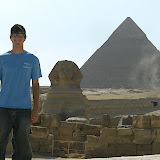
Last week I took the short bus ride to the Giza area of Cairo to see the pyramids, a trip organized by ResLife (the AUC students who run the dorms; RAs and such).
From Pyramids

I never knew that the pyramids were literally right on the edge of the city; they were built for the purpose of reminding the residents of Cairo about the divinity of the pharaohs thousands of years ago and the city hasn't moved since, only gotten bigger. I was actually able to climb up inside the Great Pyramid (the biggest one) for a few dollars, which was quite an intense climb. The opening was only about 4 feet tall, so you had to crouch and climb up a steep ramp essentially. Unfortunately, I have no pictures because cameras are not allowed inside the pyramid.

One of the highlights of that trip was riding a camel for about 15 minutes:
From Pyramids

Quite the experience. It's somewhat like riding a horse, just a lot more awkward. It was definitely worth it; it's Egypt, so how can you escape without riding a camel?

For more pictures, click either the ones above or check out my picasa page.

Couple more trips coming up!


Kevin

Thursday, September 3, 2009

First Week Post: Edition 1: Driving

Here's the first edition of my 1st week Cairo blog, each with a different topic.
This post: Driving in Cairo.

Driving in Cairo is absolutely insane. Traffic laws are merely a suggestion. Lanes are essentially just a waste of paint; today I literally saw two cars in one lane, widthwise. I wish I'd been able to take a picture. The traffic is unreal; coming home at 2am on Saturday night from the airport, we got stuck in traffic. In addition, the cars drive incredibly close to each other, within inches, especially in tight traffic as cars weave in between others (albeit incredibly slowly given the amount of traffic). Furthermore, people cross fearlessly as cars fly by them on both sides, hopefully stopping or swerving in time to miss them.
All that being said, I've yet to see any accidents or people getting hit.
On the side of the road, cars will double-park and leave their doors unlocked with only a parking brake on; if someone who's parked in needs to get out, someone on the street will climb into the car and help out in pushing the car out of the way.


More to come soon!
Kevin

Monday, August 24, 2009

First post!

Hi everyone!
I'm leaving for Cairo in just a few days, so I'm writing my first blog post to test it out. My flight is at 7:05pm Friday evening, and I arrive in Cairo at 11:40pm local time on Sunday after a half-day layover in London. Orientation starts on Monday and goes til Wednesday, and classes start Sunday the 6th.


My contact information in Cairo is as follows:

US-based phone number: 508-948-0933

Address:
Kevin Machnik
AUC University Residence
16 Mohamed Thakeb Street
Zamalek, Cairo 11211, EGYPT


I will be posting pictures here, likely also with links to albums if there are multiple pictures I would like to share. I am hoping to write something at least once a week, so check back to see updates!


Kevin