Wednesday, November 25, 2009

I haven't written a post in a while, so I have a couple things to get through.

First of all: Egyptian soccer (kura). This past week, Egypt played Algeria in two different games to decide which team would qualify to advance to the World Cup qualifiers. In the first game, Egypt had to win by 2 goals to essentially tie Algeria in standings and force the final game. In a very stressful game, Egypt pulled through with a second goal in the last 3 minutes, keeping Algeria at 0 and necessitating the next game. The first game elicited much excitement on the streets of Cairo, but it was relatively tame where I live, the Zamalek area. However, there had been a few random acts of violence preceding the game and probably a few after; one beforehand had injured 4 Algerian players when people threw rocks at their bus in retaliation for Algerians keeping Egyptians players awake all night right before the previous game in Algeria. Anyway, I watched the second game with several friends at the Hard Rock Cafe just across the river from Zamalek. The game was held in Sudan so it would be "neutral territory," which was a bit of a falsehood since the Sudanese were clearly pro-Algeria. In another very tense game, Egypt was unable to secure a victory and everyone left the Hard Rock Cafe disappointed. There didn't seem to be much of a reaction on the streets, however, as I had expected. I thought that Egyptians would just end up wallowing quietly in their defeat. The next day, apparently news broke in Egypt that Egyptians in Sudan had been the victims of some violent Algerians, and the night after the game, a riot formed outside the Algerian Embassy in Zamalek (about a 5-10 minute walk from my dorm), breaking anything that would break near them from store-fronts to plastic signs. They lit things on fire and flipped a car or two. I had gone to bed early and missed all of this. The next day, much of Zamalek was on lockdown and the bridges were being controlled (Zamalek is an island) to prevent a crowd from coming and causing the disruption of the night before. The riot police were assembled en masse and many streets were completely closed (as an American who lived in the AUC dorms, I was essentially able to move freely through the barricades with only a little explanation... good Arabic practice). However, it appeared that the riots were a one-night thing and I didn't see much of anyone on the streets. Egyptians kept asking me what my opinion was on the matter (in Arabic, so even once I figured out what they were asking, I wasn't sure how to respond). They kept muttering "Al-Gez-e-eer" (Algeria). This dispute has spilled over into politics as well, something related to the foreign ambassadors to each country being recalled I guess. They take their "kura" very seriously here. Anyway, Friday was a good Arabic day for me; I got to use it some and felt relatively competent. One of the guys I was walking around with has a tendency to just stop and chat up people on the street, something I wish I wasn't so nervous about doing because it's so amazing for Arabic practice and they're almost always happy to be patient as you try to make sense and to understand them.
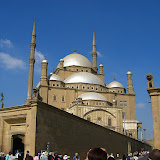
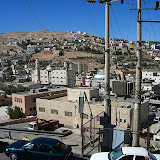
So that brings me to Saturday, an Explore Cairo day. I took a long-procrastinated trip to the Citadel (el-qalaa) with my friends Abbie and Geoff, a big castle with a few beautiful mosques inside and an amazing view of the city. Located in Islamic Cairo, it was built to ward off Crusaders.

From Citadel

From Citadel

Not too much else to say about it except that it's a must-see in Cairo and I'm glad I finally went. We did spend some time in the Military Museum, which was highly entertaining. First of all, apparently they were short on the letter a, because it was missing on plaques around the entire museum. For example, the incredibly important name, "Mohammed Ali Pasha" was often listed as "Moh mm d  li P sh ." Also, all the side rooms were closed, and there really was nothing available to see about the military "missteps" Egypt has taken in recent history.
There are a few other things in Islamic Cairo that I'd like to check out (such as Al-Azhar Mosque and the park by the same name), but I've hit all the must-sees in this city at this point. Saturday was another good Arabic day, as I had a couple good conversations with our cabbies to and from the Citadel. I say "good Arabic day" because I do have "bad Arabic days" when I feel like I'll never learn the language and what I have learned so far is useless in conversations. For example, on Thursday, an old man came up to me when I was waiting for food in a little Egyptian restaurant and started muttering at me in Arabic about Algeria and I had absolutely no idea what he was saying.

So coming up in the next week: Israel! Leaving for the border tonight, hopefully to make it up to Jerusalem by Thursday evening at a reasonable time. Then I'm heading to Tel Aviv on Sunday for a few days and taking a bus back to Cairo on Tuesday, hopefully arriving in time to get enough sleep for classes Wednesday morning. If I have internet, I'll probably have a few posts along the way, but I may end up just doing one long post when I get back.
~~

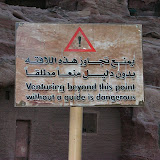
They weren't kidding! This "bamb" was highly explosive!

From Citadel

Monday, November 16, 2009

Latest Email from AUC

I just received an email from AUC about the university's smoking policy. I fully enjoy the Enforcement and Violations sections:


No-Smoking Policy


A)   Introduction: As an educational institution, the American University in Cairo is committed to maintaining a smoke-free environment on campus to protect the health of students, faculty, staff and visitors. This policy is applicable to both the Tahrir Square and New Cairo campuses.

B)    No-Smoking Areas: Smoking is not allowed in any AUC Building or Vehicle owned or leased by the University.

C)    Definitions:

1)    Smoking is defined as the burning of any variety of lighted pipe, cigar, cigarette or other smoking equipment.

2)    An AUC Building is defined as a permanent or temporary built and occupied structure, including all the spaces within the exterior perimeter (i.e. single or multiple occupancy offices, laboratories, classrooms, balconies, stairways, hallways, bridge connections, storage areas, etc.) of the structure; or within 6 meters (20 feet) of windows, air intake grills or entry/exit locations.

3)    Vehicles are defined as any motorized transport including automobiles, vans, mini vans, trucks, buses, motorcycles and utility carts.

D)    Enforcement: Enforcement of this policy will depend upon the cooperation of all faculty, students and employees to not only comply with the policy, but also to encourage others to comply in order to promote a healthy and safe environment in which to learn, work and live.

E)    Violations: In the case of a violation, the violating person will be informed of the University No-Smoking policy. Should an individual continue to violate the policy, the aggrieved party should contact the appropriate office; for University employees, the person's immediate supervisor; for students, the office of VP for Student Affairs, for faculty, the Provost office, and for visitors, Campus Security.


Approved by:
Vice President for Planning and Administration
February 19, 2009

Monday, November 9, 2009

Alexandria

I took a short trip to Alexandria this weekend. Alexandria (or al-Iskandaria, الاسكندرية) is a city in northern Egypt on the Mediterranean Sea. 

From Alexandria
It is nowhere near as big or as crowded as Cairo, and the air there is much more fresh. We (Lindsay, Madina, Abbie and I) took the 2.5 hour train ride from Cairo to Alexandria Thursday evening and got in relatively late. I was hungry, so I headed across the street from the hotel and attempted to get food from the little restaurant nearby. It was a challenge because they didn't have anything that I'm used to ordering, so I just picked something and said it, a meat concoction called Kofta. It turned out to be really good, and it was the first time I'd had it. We all ended up going back there the next night for dinner, although somehow we managed to get something very different despite ordering the same thing. I never understand why that happens here.
The first day we were there, we got up in time to get breakfast at the hotel (white bread, butter, processed cheese spread and jam; the Egyptians in the hotel got Egyptian bread and foule). We spent the day wandering along the water, stopping at various tourist attractions along the way, including the Citadel, the Unknown Soldier monument and a Roman amphitheater.

From Alexandria


From Alexandria


From Alexandria
We had possibly the best meal I've had in Egypt on Friday. Alexandria is known for its fish, so we stopped at the Fish Market restaurant and ate fresh fish. We all ended up ordering the same type of fish. We also all split a hummus salad (which was amazing; hummus is surprisingly hard to find in Cairo), essentially just a bunch of small bowls with different types of hummus next to a traditional salad. We also were given freshly-baked bread, Egyptian-style this time. It's hard to find good fish in Cairo, and I'd be wary of eating anything out of the Nile, so it's not fresh like in Alexandria.
We eventually found our way back to the hotel and got ready to go out to a bar that was a few blocks away. It was an American-style bar, supposedly one of the few bars in Alexandria since it is a conservative city.
The next morning, we again woke up just in time for the included hotel breakfast. I managed to get Arabic bread when I asked, but they still didn't give me foule, just the standard non-Egyptian spreads. Oh well, it was closer. We really only managed to see the Alexandria library on Saturday before heading back. It has a really unique design and is one of the must-sees for Alexandria.

From Alexandria
After seeing the library, we went to a park to relax for about an hour before tracking down the train station and catching the next train back to Cairo. We were back in our dorm by 7 Saturday night. It was a nice, relaxing weekend, and we saw everything there that we really wanted to. I may travel back up in December because it was so nice and the trip is cheap and short.

Tuesday, November 3, 2009

Abas' story

I know it has been a long time since I've written anything, but I haven't had much worth writing about until today. It's been a few weeks of school work and mostly monotony.
Today, however, I arrived at the Old Campus in downtown Cairo to teach my music class. When I reached the classroom I am supposed to teach in, Abas (the Sudanese refugee who runs the music classes overall) was standing outside his room. He didn't have any students yet, so we sat in my room and talked for about 45 minutes until one of his students showed up. It's 4 now and I have no students yet, so I'm assuming that I won't be teaching today. That being said, I learned more about life in a half hour from Abas than I think I've learned in any class this semester.
Abas has been sick for about a week or so (as I have, but I've only had a cold), so we started by talking about that for a few minutes. (Apparently Middle Easterners like to explain in more specifics than I am ever ready for how they are sick. If you're sick, they want you to tell them details.) Anyway, somehow the conversation moved to Abas needing to call his brother, I think to borrow some money. He mentioned that he had to sell his guitar for some money, noting that he would "buy another one later." This is a man who loves music more than anything, it seems, and the guitar is his instrument, his way of expression. Upon him telling me that he had to sell his guitar to make ends meet, it saddened me deeply. He said that his apartment costs 750LE a month, the equivalent of about $150, and apparently he has trouble paying for it. This is the same man who bought me dinner last time he saw me and refused to let me pay for it, no matter what.
Abas then explained how much he loves America and wants to eventually get his paperwork in order and procure enough money to move there. He had the opportunity many years ago but couldn't afford the visa. His eyes lit up as he was telling me that he heard that all Americans love music and that people play music in the streets. At first, that sounded ridiculous to me, but the more I thought about it, I realized how much music there is in DC that I could go listen to, often for free, but I don't make that part of my life there. He seemed disgusted that people in Cairo don't appreciate music. Abas loves jazz and can't understand why Egyptians don't.
He moved on to tell me about his past; he had a "beautiful house" and land in Sudan. He spent about four years in and out of jail for no apparent reason; no courts, no law. Eventually, about 6 years ago, he was able to leave, but he had to abandon everything he had in Sudan. He still has a paper to prove the ownership of his land. One day, he'll have a new house and land, he says.
He told me about the family members he left behind. At least 8 have disappeared; he knows that two were killed, according to the International Red Cross. When he went to inquire about the file that said who killed them in order to include it in his report for the International Criminal Court, the file had disappeared.
To anyone reading this entry, this is just another story about another refugee, I know. There's no way for me to convey the power of hearing this story first-hand. The way he could say his two nephews were killed while conveying that it was senseless but at the same time almost routine is impossible to duplicate.
I thought I was coming here to teach today; I didn't expect how much I would learn.