This is the second installment of my two post series on my trip to Israel and Palestine.
From Jerusalem, Nick, JM and I ventured into Palestine twice: once to go to Bethlehem for an afternoon and once to stay overnight in the capital, Ramallah. Bethlehem was a really interesting experience; we took the Arab bus system (there's a "Jewish" bus system, Egged, and an Arab bus system in Israel/Palestine) to the wall that separates the West Bank from the rest of Israel (i.e. Palestine from Israel, essentially), crossed through the checkpoint there and then continued to the Church of the Nativity by cab. The checkpoint was actually inside the wall, and we had to show our passports to get through. I was surprisingly entirely unaware of this wall before my trip to Jerusalem and venturing through it was truly an experience. We had no trouble getting through with our passports, but Palestinians crossing had to show their papers and scan their hands to get through. On the way back, we walked through hallways made of chain link fences and had to stand in line for about 45 minutes even though there were only about 25 people in front of us. It was a really slow process.
 |
| From Israel/Palestine |
 |
| From Israel/Palestine |
The Church of the Nativity was cool, and Bethlehem was a nice little town, mostly centered around the Church. Overall, this day was mostly uneventful and certainly not as significant of an experience as our second trip into Palestine.
Our trip to Ramallah, the administrative capital of the Palestinian Authority, was a really great learning experience. We stayed with Nick's friend John, a GW grad that Nick knew freshman year. The 3 of us arrived in the city (once again, by Arab bus, but we didn't need to go through a checkpoint to go in this time) a few hours before we were supposed to meet up with John, so we wandered around a bit on our own and visited Yassir Arafat's tomb. It was really decked out in Palestinian excitement; it was a strange experience to be there, especially considering the way Arafat is portrayed in the US.
 |
| From Israel/Palestine |
For the first few hours that we were there, we were so incredibly nervous. Before we met up with John, we basically assumed that every Palestinian we passed knew we were American and hated us for it. We were all a bit jumpy any time we found our way to a more secluded area, convinced that someone was just going to drive up and kidnap us. The most unnerving part was entering the security compound where Arafat is buried, past armed guards.
However, once we finally met up with John, we were completely corrected. John is a Christian Palestinian-American; he grew up in the US but most of his extended family currently lives in Ramallah. He is working for a non-profit in Ramallah, regularly traveling between there and Jerusalem. His perspective was incredibly interesting; sympathetic of the Palestinian cause but putting equal blame on them for the continuation of the conflict. He is from a clearly wealthy family in Palestine and benefitted from an American education. I will continue with notes about the trip after the travelogue-type description.
After visiting Arafat's tomb, JM, Nick and I found our way back downtown, where we found a little restaurant to enjoy a beer or two. We then headed to John's family's store to meet up with John where we chatted with his uncle for a few minutes until John arrived. The five of us went next to John's apartment to drop our stuff off. We spent the evening in two separate bars before heading back to John's place for the night. In the morning, we grabbed breakfast at a little restaurant that serves real bacon (incredibly difficult to find in the Middle East where they don't eat pork!).
After breakfast, we took a "service" (pronounced in a French accent, like say-r-veese) to Taybeh (tie-bay), a small Christian village about 20 minutes outside Ramallah. The views were amazing, but we went there to visit the only Palestinian brewery, named after the town. They gave us a small cup of beer while we watched a short video on the history of the brewery, then we got a tour of the tiny warehouse-like room where the vast majority of their beer is made. There is another brewery that also makes Taybeh beer in Germany, and much of their exported beer is made there. It seems to be a lucrative little business. Look out for Taybeh beer in the US this summer! After some pictures of the views, we jumped back into a service to head back to the city. From there, we continued on through Jerusalem to Tel Aviv, where we spent a rather uneventful night.
 |
| From Israel/Palestine |
 |
| From Israel/Palestine |
 |
| From Israel/Palestine |
Our group split up from the next morning, and JM and I headed back to Cairo with only minor difficulty. At the Egyptian border, we discovered that we had missed all of the busses back to Cairo, and therefore we had to pay an excessive amount to take a shared cab back to the city. It was a great language experience, though, because as we were waiting for others who might want to split the ride and the cost with us, we had conversations in Arabic with the local Bedouin men who were waiting around to drive people back as well. We were exhausted and Arabic conversing was difficult, but it was definitely worthwhile.
So, some important notes from Palestine that made the experience so important.
Going forward: I apologize if I become political from this point on. It is almost unavoidable when talking about this issue. While I try to open my mind to as many perspectives as possible, I find myself increasingly falling on one side of the argument. I will try to stick to what I saw and heard, but I apologize if I stray.
-John clarified to us that Palestinians in Ramallah are not angry at Americans who come there; rather, they are grateful. This concept was supported by the conversation we had with the restaurant owner in the city, who explicitly said that the American government needs people like us, people who have actually traveled to the Middle East and experienced it ourselves. They want us to come and see Palestine. They don't want people making policy who've never seen it with their own eyes. While clearly it's not feasible for every government employee to travel to the Middle East, it is an important for everyone to be informed about every side of an issue, not just the popular American point of view.
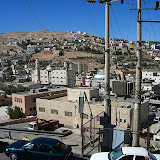
-If there are two things that I would encourage you to research in relation to the current Middle East situation, it is the Separation Wall and Israeli settlers. While I have discussed the former, the latter is even more pressing. Israeli settlements are the biggest problem in the conflict. Israeli citizens (generally Zionists who believe in the existence of an Israel that spans from the Mediterranean Sea to the Jordan River) are building communities in "Palestinian" lands, specifically East Jerusalem and the West Bank. While the American government has been pressing the Israeli government to stop these settlements, they have refused despite their blatant disregard for international law and the welfare of the Palestinian people. These settlements are built next to or within existing Palestinian communities, not in the expanses of open land in the West Bank. The worst part? Only Israeli citizens are allowed water 7 days per week. Palestinian houses have water tanks on their roofs to collect and store water when it is running about 3 or 4 days per week so that they can actually have water 7 days per week. This includes John's apartment. As we looked out over the hills, we could see which communities were Arab and which were Jewish (Israeli) by presence or lack of water tanks on the roofs of the houses. There have been many instances of violence between Palestinians and settlers; settlers are often known to carry guns around for the sake of "self-defense." Unarmed Palestinian civilians have been shot in the West Bank by Israeli settlers. It's like sending American civilians to build a permanent community immediately next to an Iraqi village that hates the American occupation, then giving them blatant preferential treatment. Of course there is going to be violence, from both sides. Why do it?
-Controls on Palestinians: they are not allowed Israeli passports, and Palestinian passports do not exist. In some cases, they are given Jordanian passports, but generally they are just unable to leave whichever Palestinian area they live in (the West Bank or Gaza). Residents of Jerusalem may travel into the West Bank but (Palestinian) West Bank residents may not travel to Jerusalem or anywhere else in Israel without special permission. Until recently, they were unable to travel between cities in the West Bank. Of course, the standard response to this is that it is necessary to ensure the safety of Israeli citizens. To that, I wonder why Israeli citizens are being sponsored by their government to move into the West Bank. While the threat to Israelis is real, so is the arguably excessive oppression.
On the other hand:
-Ramallah is beautiful and well run. Their cab system is far superior the system in any American city I've visited. All rides fall into one of a few price brackets, so it's never a guessing-game about how much your ride will cost. They have shared cabs that leave from certain locations and will travel anywhere given enough interested in that location. The roads are well-paved and clean. Many families (like John's) are very well off. So to opponents of a two-state solution that argue that there the Palestinian infrastructure is gone because of Israel, I beg to differ. The government in the West Bank is clearly not in shambles if Ramallah can look like that.
But a response:
-According to John, within the past two years, a political assassination occurred in Ramallah, within a few blocks of where JM, Nick and I stopped for a drink before meeting up with John. Israeli vehicles appeared on the streets, a person was shot dead, and then they disappeared. The Israeli presence in the city is real, and Israeli policy is that they control areas outside of the major cities. At any moment, according to John, Israeli security forces could appear on the streets.
-*Furthermore, Israel controls the borders from the Mediterranean Sea to Jordan. What does that mean for the Palestinian economy? Everything costs significantly more when imported. Luxury cars cost twice as much as their actual purchasing price by the time Israel and the Palestinian Authority both collect taxes (the rich families in Ramallah can somehow still afford them; we saw many on the street). A major potential source of Palestinian income, olive oil, is diminished by Israeli controls on exports, and by systematic destruction of olive trees in the West Bank.
*Note: I have not done any study on this, so I cannot verify the truth behind this or give any more specific details.
In summary, the Palestine-Israel conflict is far more complicated than I ever imagined. Traveling there has opened my eyes in some ways and encouraged me to study more about the subject. Also, it is important to distinguish between a broader Arab-Israeli conflict and the more localized situation. Many Arab countries are also hostile to Palestinians, as their presence stirs up conflict as well as they struggle to return to their alleged rightful homeland.
I look forward to returning to the area at some point in the future to gain a broader perspective of the situation. While I have spoken with many American Jews, I have not had the opportunity to converse with any Israelis on the subject. Also, I would like to learn about the situation from a Palestinian, born, raised and living in the country, as well as expand my journey beyond the rich, essentially 100% Palestianian, Ramallah.


No comments:
Post a Comment